


There are many misconceptions about digital drawing—such as that it isn’t “real” drawing, or that it’s much easier than drawing on paper. My view is that the two approaches are highly complementary, that they enrich one another, and that each has its own advantages and disadvantages. Neither one is entirely “easier”; the speed and quality of the drawing depend on the artist’s skill.
Beginnings
Half of my drawing life was spent in traditional drawing, mainly because I belong to a generation that grew up without computers (yes, I’m that young!). My drawing education consisted of preparations for the academy and for architecture, and it was entirely traditional. My first encounter with more serious digital drawing was actually coloring hand-drawn pencil sketches in Photoshop. Of course, using a mouse—since tablets and pens weren’t yet in wide use at the time (we’re talking about the late 1990s).
At some point I grew tired of the mouse and treated myself to a small Genius tablet with a pen, which I used for a long time (I think the model was Genius G-Pen 450). The biggest challenge with these tablets that don’t have a screen is training yourself not to look at your hand while drawing, but at the monitor in front of you. That’s difficult at first, and the strokes aren’t the same as when drawing on paper, especially when you need to make longer lines, which can be frustrating. Plus, the small size of the tablet doesn’t allow you to move freely the way you can on real paper.
During this period I was still using Photoshop and drawing exclusively in raster. Here are some results from that time:

Progress
I made a big step forward in 2012 when I received a Wacom Bamboo CTH-670 from my husband - it was a real revelation. Around that time, he also introduced me to what was then called Manga Studio, now known as Clip Studio Paint, so over time I switched to it over Photoshop. That was when I began working exclusively digitally—from the first sketch to the final piece, everything was done on the computer.
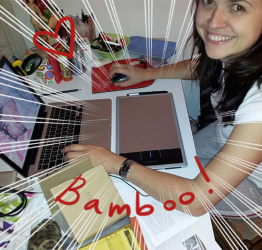
There was a period of several years when I became a mother for the second time, and my full-time job, daily responsibilities, and chronic impostor syndrome pulled me away from drawing. However, a calling is a calling - it has its grasp on you - and when the pandemic began, I started again. Traditional drawing also made a comeback for me when I treated myself to watercolor colours and received a huge set of alcohol markers.
If we compare the roles of digital and traditional drawing, as I mentioned at the beginning, I believe they complement each other. For someone learning to draw, I think it’s crucial to draw on paper. In traditional drawing, every moment of your work leaves a mark - there’s no “undo” command - and that’s the best and fastest way to master anatomy, perspective, and other essential basics. Yes, modern drawing programs have perspective tools, but you need to develop a sense for it, to train your hand and eye.
Digital drawing, on the other hand, offers the possibility of experimenting, especially with composition and colors. I’ve always struggled with colors and avoided coloring my drawings for a long time. Digital drawing allowed me to try out colors, adjust them, and somewhat overcome that limitation. Another significant advantage is that digital drawing produces illustrations ready for use, which can go straight into prepress. In the gallery you can see some of my digital works.
And now?
That brings us to the current phase, when I practice drawing equally on paper and on the computer. For several years now I’ve had a sketchbook (I’d love to call it an art journal, but I don’t draw in it nearly regularly enough, and it’s far too chaotic to deserve that name). I try to draw as much as possible on paper, because I feel that’s my authentic expression, and it’s important to me to develop it. There’s always something to learn—through new techniques and different materials. Experimentation is an extremely important part of the process.
For the projects I work on, which are mostly illustrations, I usually sketch on paper, scan the sketch, and then do the lines and colors digitally. I have the impression that my pencil sketches are much more natural and better than the ones I make digitally. The possibility of endlessly undoing, cutting, and moving things around sometimes pulls me away from the original idea, and I end up with a result that may be anatomically more correct, but generic and inauthentic.
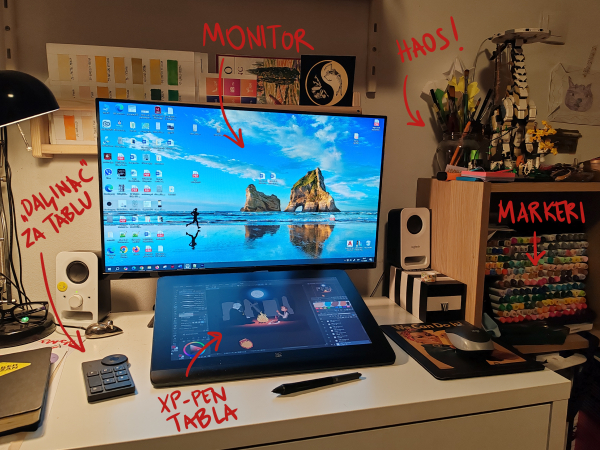
Today I mostly use Clip Studio Paint, because it has the option of working with lines in a vector layer, while colors and backgrounds are raster, which helps with precision. I’ll cover CSP in another post, because I really love that program—it’s not too expensive, and it offers a ton of great features for illustration, comics, and animation. As for tablets, the Bamboo has gone into well-deserved retirement, and I’ve switched to an XP-Pen Artist Pro 16 with a screen (which will also get its own post).
I had some doubts about switching to a tablet with a screen, but I haven’t regretted it, because it truly allows for “organic” drawing, the closest thing to drawing on paper. My impression is that I’m now much faster working with this tablet, the image is extremely realistic, and I practically have an extra screen—on the tablet I draw, while on the monitor above I keep, for example, references.
So my setup on my tiny desk currently looks like this:
I still keep the Bamboo tablet as a backup—for the younger generation starting to draw and experiment, but also in case this modern technology ever fails me.
The reason I’m writing about this topic is that the experiences of colleagues meant a lot to me when I was choosing a new tablet. Of course, experience is individual, and not the same things will suit all of us, but every piece of information helps, because any serious hardware or software is an investment.